
Chompy | Boston Terrier | Los Angeles, CA | In-Training
- Jose Ayala
- Oct 17, 2025
- 20 min read

Updated: Nov 5, 2025

Meet Chompy! He is a six year old Boston Terrier who has joined us for our Three Week Board and Train Program. Chompy is here for basic obedience, leash pulling, and reactivity towards other dogs. Though a little hesitant initially when going on walks, he will pull on his leash once he gets going. Chompy’s goal is to improve his leash manners, exhibit better behavior at home, and prevent him from reacting when he is around other dogs. Over the next twenty one days, he’ll be working on these aspects, as we help Chompy become the best pup that he can be. Check in to see his progress!
Chompy and I focused his recall while also introducing him to the concept of leash pressure. This exercise plays an important role in building communication and trust between dog and handler. Because leash pressure is a new experience for Chompy, patience was key throughout the process. I made sure to work at his individual pace, ensuring he remained comfortable and confident without feeling overwhelmed. To help Chompy understand the meaning behind the leash pressure, I gently applied light tension and released it the moment he showed even the smallest intention of moving toward me. Each time he made progress, whether a step or even a shift in body language, he received immediate verbal praise to reinforce his effort. This method helps Chompy learn that following the guidance of the leash leads to a positive and rewarding outcome. As the session continued, Chompy began showing signs of understanding and responding more willingly. With consistent practice and continued positive reinforcement, I am confident that his responsiveness and confidence will keep growing. Over time, this foundation will not only strengthen his recall but also improve his overall communication and cooperation on leash, setting him up for long-term success.


Chompy and I focused on practicing his place command. While Chompy is naturally a confident pup, he did show some initial hesitation when introduced to new place objects. This is completely normal, as unfamiliar surfaces can sometimes make dogs uncertain about stepping onto them. To help Chompy work through that hesitation, I took things slowly and made sure to create a positive and encouraging experience. I first allowed Chompy to sniff and explore the object at his own pace so he could become familiar with it. Once he showed some curiosity, I applied gentle leash pressure and paired it with one of his treats to guide him onto the surface. When Chompy placed his front paws on the bench, I immediately marked the behavior with praise and rewarded him with his treat. This combination of patience, guidance, and positive reinforcement helped build his confidence and understanding of what was being asked. After a few repetitions, Chompy began to respond and started stepping onto the bench more willingly and with noticeably more confidence. This progression shows that Chompy is not only learning the mechanics of the place command but also building trust in the process and developing the confidence to tackle new challenges. With continued practice and consistency, he’ll soon approach new place objects with ease and excitement, demonstrating how effective positive experiences can be in helping dogs grow both in skill and self-assurance.

Chompy and I have been working on his heel, which requires him to walk beside me on my left side. This command is crucial for ensuring that he remains focused and close during our walks, thereby fostering a safer and more enjoyable experience for both of us. To reinforce the concept of heel, I employed a technique where I would stop walking whenever Chompy pulled away from my side. This method involved making a U-turn and guiding him back towards my left with appropriate leash tension. When he would try to veer off, I applied gentle leash tension towards me to work him through it, and once he came back to position on my left side, I released tension and continued on our walk. This approach not only helps Chompy understand the desired position but also teaches him the importance of maintaining proximity and attentiveness to my movements. While Chompy is still mastering this skill, I am committed to incorporating the heel command into every walk moving forward to solidify his understanding and compliance.

Chompy and I focused on addressing his reactivity toward other dogs during today’s session, and I am pleased with the progress he demonstrated. Throughout our training, Chompy maintained an impressive level of composure and showed no signs of reactivity when other dogs were present. He was able to walk calmly past nearby pups without losing focus, which is a clear sign of increased confidence and trust in guidance. One particularly noteworthy moment was when Chompy held his sit position as another dog passed by — a situation that can often be challenging for dogs with prior reactivity. His ability to remain steady and responsive in that moment highlights the effectiveness of his ongoing training and his growing ability to manage excitement or uncertainty. As we continue to build upon this success, my plan is to gradually increase Chompy’s exposure to more dog distractions, ensuring that his progress remains consistent and reliable in different settings. This gradual and structured exposure, similar to the approach I used with Mouse, will help reinforce Chompy’s calm behavior and strengthen his confidence in real-world scenarios.


Chompy and I focused his down command, a foundational obedience skill that helps promote calmness, patience, and self-control. This particular command required a great deal of patience, as Chompy initially showed some hesitation and a bit of stubbornness when learning the motion. To prevent him from becoming frustrated or disengaged, I incorporated short breaks throughout our session, allowing him time to reset and maintain a positive mindset toward the exercise. To guide him into position, I applied gentle leash tension downward while he was in a sit, releasing the pressure the moment he made any attempt or intent to move toward the ground. This technique helped him understand that following the direction of the leash leads to comfort and praise. Although Chompy occasionally stiffened his front paws or came out of his sit instead of lying down, we used each moment as a learning opportunity by calmly resetting and trying again. With each repetition, he began to make better progress and eventually followed through with the full down motion. While Chompy occasionally rolled to his side rather than maintaining a full down, this is still a good indication that he’s becoming more comfortable with the position. With continued practice and consistency, I have hopes that Chompy will develop a reliable down command. His willingness to keep trying, even when challenged, shows his growing focus, and I look forward to further refining this skill in our upcoming sessions.

Chompy and I focused today’s session on strengthening his command reliability in an environment with minimal to no distractions. Since he has shown progress with these commands at home, I decided to take him to a local park to help him generalize his training and practice in a setting that offered new sights, sounds, and smells. At first, Chompy had a bit of difficulty maintaining his place and down commands, which is expected when transitioning to a new environment. With patience, repetition, and clear communication, he quickly began to adjust and show improvement. As we continued, Chompy became more responsive and consistent, following through with the exercises with growing confidence. His ability to adapt and focus in a new setting is an indicator of his progress. Moving forward, now that Chompy is demonstrating reliability with his commands in lightly distracting environments, he will be ready to begin working on building distance and duration in the coming days—further developing his impulse control and overall obedience.


Chompy and I have been maintaining a consistent walking routine, going on two to three walks around the neighborhood each day. These walks have been an excellent way to reinforce his leash manners and build his confidence in different environments. At times, Chompy has a tendency to pull forward or try to walk ahead of me, but with the help of e-collar stimulation paired with a verbal “heel,” I have been able to guide him back into position and keep him focused on walking nicely by my side. During our walks, we occasionally encounter dogs barking from behind gates or doors, which can be a challenging distraction for him. On a few occasions, Chompy fixated and showed mild signs of reactivity, but by calmly using the e-collar in combination with a verbal “off,” I was able to redirect his attention and help him settle. These moments are valuable opportunities for him to practice maintaining composure around common real-world distractions. Considering his breed and energy level, our walks are kept to about fifteen to twenty minutes, including a short break for water and potty time to prevent him from tiring out. This structure not only ensures that Chompy stays comfortable but also helps him associate our walks with a positive and manageable routine. What has been most encouraging to see is the progress Chompy has made with consistency. Early on, he would sometimes hesitate or “shut down” before starting his walks, but with patience, structure, and routine, he now begins them willingly and with a more confident attitude. Each walk continues to strengthen his obedience, improve his focus, and build his trust in the training process.

Chompy and I spent our session working around both people and dog distractions to continue building his focus and composure in more stimulating environments. We followed the same training approach previously used with Mouse, emphasizing calm behavior, impulse control, and responsiveness while maintaining his position. Chompy responded very well to this exercise and showed noticeable progress in his ability to remain composed despite the added challenges. While there were a few moments where Chompy broke from his sit as people passed nearby, I was able to calmly guide him back into position each time, reinforcing the importance of staying steady until released. This type of repetition helps strengthen his understanding of expectations even when distractions are present. A particularly encouraging moment came when two dogs walked directly past him—Chompy remained focused and did not react, demonstrating how far his training and confidence is coming along. Overall, Chompy is showing improvement in his ability to manage his excitement and maintain obedience in public spaces. Continued exposure to controlled distractions like this will help solidify his calm and reliable behavior, ensuring he remains focused and well-mannered in a variety of real-world situations.


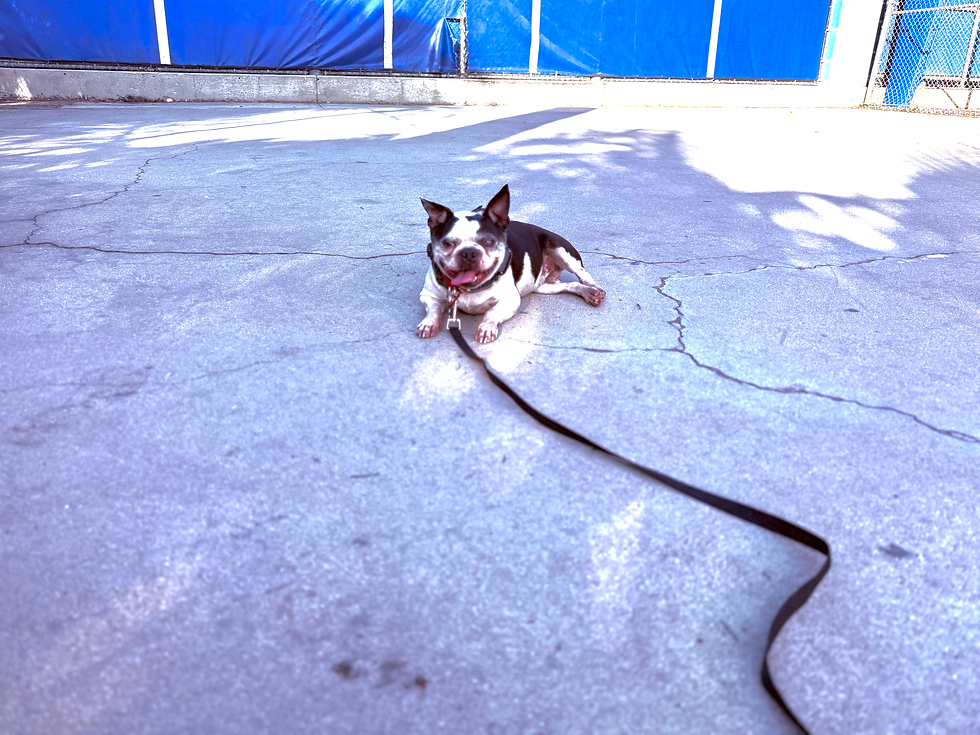

Teaching distance and duration using a long line is a critical and professional component of effective dog training. It not only builds a reliable communication channel between the handler and the dog, but also lays the foundation for impulse control and advanced obedience. The long line serves as both a physical safety net and a valuable tool for teaching the dog how to succeed at greater distances and for longer periods of time, all while reinforcing engagement and responsiveness in increasingly distracting environments. From a behavioral standpoint, working on distance and duration helps strengthen Chompy’s understanding of commands in real-world scenarios, where distractions are inevitable and immediate correction or reinforcement may not always be possible. Training him to respond to commands such as sit, down, or place from a distance requires mental discipline, self-control, and trust. These are not innate behaviors for most dogs, and therefore must be cultivated gradually and consistently. The long line allows me to systematically increase the difficulty level by adding distance and time while still maintaining control, preventing Chompy from rehearsing disobedience or developing bad habits like bolting or ignoring cues. Distance work on a long line also enhances his focus on me. When he learns that distance from me does not mean a lack of accountability, Chompy begins to see obedience as a continuous expectation—not something that is only enforced when he is within arm’s reach. This is especially important for advanced work such as recall in open spaces, hiking, or service dog tasks. Through long-line training, Chompy begins to generalize commands and learns that they apply regardless of location or environmental changes. Duration training teaches him to hold a command until released, rather than anticipating or making decisions independently. This builds patience, clarity, and reliability. The long line allows me to reinforce these concepts without relying solely on physical proximity. It ensures that Chompy understands that even if I am 7 or 15 feet away, commands must still be respected and maintained. Without this foundational work, dogs often break position or fail to come when called because they have never been properly conditioned to work at a distance or for extended periods of time. In practical terms, teaching distance and duration with a long line also provides crucial safety benefits. The long line acts as a tether of accountability, allowing freedom without complete risk. It gives me the means to interrupt bad choices, reinforce good ones, and communicate effectively, even when he is far away.

Consistency and follow-through are fundamental components of effective dog training, particularly when it comes to teaching and reinforcing commands. One of the most critical aspects of this process is resetting your pup back into its original stationary position when he breaks a command, rather than allowing him to self-correct or move on without accountability. This practice plays a significant role in shaping reliable obedience, building clear communication, and maintaining the integrity of the training process. When Chompy is given a command, such as sit or down, and chooses to break that position prematurely, resetting him back into position sends a clear and consistent message that the command was not optional, nor was it completed correctly. This simple yet powerful action reinforces the expectation that the command is to be maintained until I release him, rather than allowing Chompy to determine when the exercise is over. Allowing him to break position without resetting often leads to confusion and inconsistent behavior, as he learns that he can self-dismiss or disregard commands without consequence. Additionally, resetting Chompy back to his position strengthens his understanding of accountability and enhances his mental discipline. It encourages Chompy to think critically and remain engaged, as he realizes that success is measured not just by executing the command initially, but also by holding that position until instructed otherwise. Follow-through and resets help prevent the development of stubbornness, selective listening, and impulsivity, which are all common challenges in dogs. Without clear correction and redirection, Chompy may perceive his own choices as equally valid to our commands, which can erode obedience over time and create frustration for both Chompy and ourselves. By calmly and consistently guiding him back into position, I teach persistence, patience, and respect for the training process. Ultimately, resetting Chompy when he breaks a command is not about punishment, but about reinforcing structure and clarity. It is one of the most effective ways to ensure he fully understands what is being asked, remains focused, and develops into a reliable and well-mannered companion.

Practicing distance and duration around other dogs is one of the most beneficial exercises for helping a dog-reactive dog like Chompy build confidence, impulse control, and emotional stability. For dogs that tend to overreact when seeing other dogs, the issue often stems from a combination of overexcitement, insecurity, or a lack of clear communication between the dog and the handler. By incorporating structured distance and duration work into training sessions, we can help Chompy learn to remain calm and composed in the presence of triggers, rather than reacting impulsively. The principle of distance allows us to work within Chompy’s comfort zone—far enough from distractions that he can remain aware but not overwhelmed. This distance acts as a safety buffer, giving him the opportunity to process what he sees while staying under threshold. Over time, as Chompy shows consistent calmness and focus, we can gradually close that distance, reinforcing the idea that the presence of other dogs does not pose a threat or require a reaction. This gradual desensitization helps rewire his emotional response, replacing stress or excitement with neutrality and confidence. Duration, on the other hand, teaches Chompy patience and reinforces the concept of calmness over time. Holding commands such as sit, down, or place for extended periods around other dogs challenges him mentally and emotionally, helping him develop impulse control. Instead of reacting immediately to movement or noise, he learns that staying still and composed leads to positive outcomes and clear communication from his handler. This practice builds trust and reliability—two essential components for long-term behavioral success. Furthermore, working distance and duration around other dogs strengthens the bond between Chompy and yourself. Each successful repetition communicates to Chompy that you are in control and that he does not need to handle situations on his own. This trust is crucial in transforming reactivity into responsiveness. As Chompy learns to look to you for guidance rather than reacting independently, his confidence grows, and his ability to maintain composure improves dramatically. Ultimately, these exercises go beyond obedience—they address the emotional foundation of reactivity. By focusing on structured distance and duration work, we’re not just managing Chompy’s behavior, but actively helping him develop the self-control and resilience necessary to navigate the world calmly and confidently, even in the presence of other dogs.

Pack walks offer tremendous benefits for dogs like Chompy, especially when the goal is to improve socialization in a structured and positive way. Unlike unstructured play or chaotic dog park environments, pack walks provide an opportunity for dogs to coexist peacefully in the presence of other dogs while maintaining focus, calm energy, and self-control. For a dog such as Chompy, who is continuing to build his confidence and refine his social skills, pack walks serve as an invaluable training tool that reinforces calm behavior and proper social etiquette. During a pack walk, the emphasis is not on direct interaction, but rather on calm coexistence and neutrality. This allows Chompy to learn that the presence of other dogs does not automatically signal playtime or pose a threat. Instead, he begins to associate being around other dogs with a calm, structured, and enjoyable experience. This shift in perception helps reduce reactivity, builds confidence, and encourages Chompy to look to you for guidance. Over time, these experiences help strengthen his ability to remain composed and attentive, even in situations that would have previously been overstimulating or overwhelming. Pack walks also promote a sense of teamwork and belonging. Moving together as a group fulfills a dog’s natural instinct to travel in a pack, which fosters security and stability. For Chompy, this creates a controlled and supportive environment where he can observe and mirror the calm behavior of other balanced dogs. Exposure to well-mannered dogs provides valuable learning opportunities through observation, helping him better understand social cues and appropriate behavior in different contexts. Additionally, the physical exercise and mental engagement of a pack walk help release excess energy in a productive way, which contributes to Chompy’s overall balance and emotional well-being. The rhythm of structured walking encourages relaxation, focus, and impulse control—key elements for continued progress in his training. This controlled environment also allows you to reinforce commands, practice leash manners, and strengthen Chompy’s communication and trust. In essence, pack walks are far more than just group walks—they are a form of behavioral enrichment and social conditioning. For Chompy, they serve as a bridge between training and real-life application, giving him the opportunity to generalize his obedience skills and confidence around various dogs and people. With consistency, pack walks will continue to enhance Chompy’s social development, reinforce his calm mindset, and strengthen his ability to remain well-mannered and composed in any environment.


Understanding and managing Chompy’s body language is one of the most effective ways to prevent reactive behavior toward other dogs and to build better communication between you two. Recognizing the early signs of discomfort or arousal allows intervention before Chompy escalates into a reaction, keeping training calm, structured, and productive. When observing Chompy around other dogs—whether at home, on walks, or in public spaces—it’s important to pay close attention to subtle changes in his posture and expression. Early indicators of potential reactivity often include a sudden shift in body tension, such as his muscles stiffening. His ears may perk forward, his mouth may close tightly, and his eyes may fixate or “lock on” to the other dog. These are signals that his focus is narrowing and that he’s beginning to assess the other dog’s presence as something significant. If not redirected early, this focused attention can quickly build into barking, lunging, or pulling. In these moments, it’s crucial to intervene before Chompy crosses the threshold into a reactive state. A calm verbal redirection or light e-collar stimulation paired with a known command, such as heel or sit, helps shift his attention back to you and interrupt fixation. Maintaining a calm and confident tone is key—any tension on the leash or anxious energy from you can transfer to Chompy and heighten his alertness. Rewarding moments of calm focus and disengagement from the other dog reinforces the behavior you want to see repeated. Working on this at home can start with controlled setups. Practice basic obedience—such as place, down, and sit—while introducing low-level distractions at a comfortable distance. This teaches Chompy that he can remain calm and follow direction even when something catches his attention. As he improves, gradually increase the level of distraction or reduce the distance, but always stay within a range where he remains responsive and composed. In public settings, it’s beneficial to create positive experiences where Chompy can observe other dogs without being forced into close proximity. Parks, pet-friendly shopping areas, or quiet neighborhoods are good starting environments. Maintain structured walks where he stays in position and relaxed by your side, reinforcing calm behavior and rewarding moments when he chooses to focus on you rather than his surroundings. Over time, these consistent, balanced exposures teach Chompy that other dogs are simply part of the environment—not something he needs to react to or control. By paying attention to Chompy’s body language and working proactively rather than reactively, you can continue to build his emotional stability.

Chompy continues to make excellent progress in maintaining his composure and calmness in the presence of other dogs. His ability to remain relaxed in these situations reflects the consistency and structure that have been reinforced throughout his training. When encountering other dogs, Chompy shows noticeable improvement in his focus and overall demeanor—he no longer reacts impulsively, but instead displays a more confident and controlled state of mind. This steady progress is a direct result of clear communication, proper handling, and calm energy being projected by me as his handler. It’s important to remember that Chompy’s behavior is often a reflection of the energy and mindset of the person working with him. Dogs are highly perceptive to human emotion, and any tension or uncertainty from the handler can easily transfer to them, especially in moments of potential reactivity. Remaining composed, confident, and consistent is key to helping Chompy feel secure and trust that anyone handling him is in control of the situation. When his handler maintains a relaxed posture, steady breathing, and balanced tone, it sends Chompy the message that there’s no threat or need to react. By continuing to approach these interactions calmly and confidently, Chompy will only strengthen his ability to remain neutral around other dogs. His progress so far shows that with leadership, patience, and consistency, he is fully capable of navigating social situations with ease and stability. The more you maintain that composed mindset, the more Chompy will mirror that same calm energy.


When it comes to training Chompy, keeping sessions short and purposeful is especially important given his breed’s physical structure and short snout. Dogs with shorter muzzles, known as brachycephalic breeds, can be more prone to overheating and respiratory fatigue due to their limited ability to regulate temperature and airflow. Because of this, extended periods of activity or long training sessions can place unnecessary strain on their breathing and overall stamina. By keeping sessions brief, we ensure Chompy remains comfortable, engaged, and physically safe throughout the training process. Shorter training sessions also help maintain mental clarity and focus. Just like people, dogs can become mentally fatigued when asked to concentrate for too long—especially during repetitive exercises or new learning experiences. Chompy benefits most when sessions are kept within a manageable timeframe that allows him to stay attentive and motivated. Frequent but shorter sessions help reinforce consistency, prevent frustration, and make learning enjoyable rather than overwhelming. Additionally, shorter sessions make it easier to end on a positive note, which is a key component of effective training. This allows Chompy to associate his training with success and confidence rather than exhaustion. It also provides more opportunities throughout the day for structured breaks and reinforcement of good behavior in different environments. In summary, keeping training sessions brief not only protects Chompy’s physical well-being but also enhances his mental engagement and overall learning experience. The goal is always quality over quantity—ensuring that each moment of training is productive, rewarding, and suited to his individual needs as a short-snouted breed.

Chompy naturally enjoys engaging in rough play, he’s enthusiastic, energetic, and tends to use his body in a way that can appear intense to the human eye. This type of play, while completely normal for many dogs, can sometimes be mistaken for aggression because it involves a lot of movement, vocalization, and physical interaction. When Chompy tried to initiate play, he did so in his typical rough-and-tumble manner, but the other dog preferred a calmer form of interaction. Despite their different play styles, the other dog did not feel threatened or uncomfortable around Chompy. This shows that dogs are often excellent at reading one another’s body language and energy. The other dog recognized that Chompy’s intent was playful, not confrontational, and therefore did not react defensively or aggressively. Dogs communicate primarily through energy, body posture, and subtle physical cues. When Chompy does show signs of being aggressive, his energy becomes tense, focused, and serious—body stiff, and eyes locked. In contrast, Chompy’s playful energy is loose, bouncy, and lacks the kind of tension that signals a real threat. Other dogs are usually quick to distinguish the difference, even if humans can sometimes misinterpret what they’re seeing. As Chompy continues with his program, I am helping him refine his social awareness with continued exposure and positive interactions, which helps Chompy improve his social skills while maintaining a playful nature.

When working with Chompy, it’s important to understand that moments of stubbornness or hesitation are a natural part of the learning process. Reconditioning commands during these moments plays a key role in reinforcing reliability, focus, and respect between the handler and the dog. When Chompy chooses not to follow through on a command, it isn’t necessarily defiance—it can stem from distraction, uncertainty, or testing boundaries. By calmly and consistently reconditioning those commands, we help him understand that following through is not optional, but rather a consistent expectation. This process builds both accountability and clarity in communication. Dogs like Chompy thrive when we as handlers maintain structure and clear follow-through, as it removes confusion and reinforces trust in the training system. Reconditioning commands also ensures that his obedience remains consistent across different environments and distractions, rather than only in familiar or easy settings. Additionally, when we take the time to patiently reset and guide him through each command, we’re not just correcting behavior—we’re strengthening his confidence and improving his engagement. Chompy learns that persistence and cooperation lead to success and positive reinforcement, while inconsistency or resistance doesn’t yield the same results. Over time, this consistent pattern helps him develop a dependable response to every command, even in moments when he might feel distracted or unmotivated. Ultimately, reconditioning commands when Chompy is being a little stubborn ensures that his training remains balanced, reliable, and fair. It keeps him mentally sharp, reinforces his respect for guidance, and helps maintain a strong, trusting relationship between him and his handlers.

Mouse and Chompy had a great reunion today and did an excellent job working together during our park walk. To begin, I had both dogs walking calmly on one side to help them settle into a comfortable rhythm together. Once they were relaxed and showing good focus, I transitioned Mouse to my right side while keeping Chompy on my left. This adjustment allowed each dog to work individually while still maintaining awareness and composure around one another. Both responded beautifully to this setup, maintaining steady engagement and clear communication throughout the walk. This type of structured walking is an important exercise for promoting balance, focus, and teamwork between the two dogs. It helps reinforce calm energy, good leash manners, and the ability to stay responsive to you rather than becoming distracted by each other or the environment. At home, you can continue practicing this approach by doing short, structured walks around your neighborhood or even in your backyard. Begin with both dogs walking on one side to establish rhythm and focus, then alternate sides after a few minutes to help them build neutrality and responsiveness from different positions. Keep sessions positive and calm, rewarding relaxation and loose-leash walking. Over time, this consistency will help both Mouse and Chompy become even more confident and reliable walking partners, strengthening their bond and overall obedience in shared environments.


Chompy and Mouse are making progress in their recall training, particularly when working together as a team. At first, when we practiced recall exercises at home, they would often become tangled or stop short—sometimes directly in front of me, other times off to my right. To help them better understand the exercise and improve their coordination, I began working with each of them individually for several repetitions before reintroducing them as a pair. This approach allowed both dogs to focus more clearly on the command and gain confidence in responding without distraction. Once reunited, they quickly began to grasp what was being asked of them, showing noticeable improvement with each repetition. Now, whether walking on the same side or on opposite sides, both Mouse and Chompy are demonstrating an understanding of recall and are responding consistently and enthusiastically. Their progress reflects not only their growing communication and teamwork, but also their developing focus.


With Chompy and Mouse preparing to return home, I want to take a moment to express my gratitude for the opportunity to work with both of them. It has been a genuine pleasure watching their progress and seeing how far they have come throughout their training journey. Both have shown great potential and willingness to learn, and with continued consistency, they will only continue to grow and strengthen their skills. As you transition back to working with them at home, remember the importance of maintaining consistency in their training routine. Take time to work with each dog individually before bringing them together, as this helps reinforce focus, structure, and clear communication. Just like people, dogs can have their off days—moments where they may be less attentive or more distracted than usual. During those times, staying patient, calm, and collected will be key. A positive and balanced mindset from you will always help them stay grounded and responsive. There may be challenges ahead, but each one presents an opportunity to strengthen your bond and reinforce what they’ve learned. Should you have any questions, need guidance, or simply want a refresher, please don’t hesitate to reach out. I am always happy to help ensure Chompy and Mouse continue on the right path. Thank you again for trusting me with their training and care. They will truly be missed. Great work, Mouse and Chompy!


Comments