
Chip | Golden Retriever | Encino, CA | In-Training

Updated: Apr 25

Please welcome Chip!
Chip is a four-and-a-half-month Golden Retriever from Encino, California who has joined us for our Two-Week Community Board and Train Program. He’s a fun-loving, energetic pup with a lot of potential, and he’s been brought to us to establish a proper structure for this bold and daring little guy. Chip can be a sweet and energetic little guy but some habits he’s developed have started to get in the way of him being his best self.
Like many young dogs, Chip has a big personality and a lot of enthusiasm, but right now that energy shows up as nipping, counter surfing, getting into and destroying things that don’t belong to him, and struggling to listen or follow through on commands. Anything he sees as food better beware!
While these behaviors may seem small or even playful at times, they can quickly become overwhelming in a home environment. That’s why during Chip’s stay, we’ll be focusing on creating structure, clarity, and consistency in his day-to-day life. Our goal is to help him understand accountability, teaching him that his choices matter, and that there are clear expectations to follow.
We’ll be working closely with Chip on his obedience, building reliable commands both in and outside of the home, and helping him learn how to settle, make better decisions, and think before he acts. A big part of his training will also be reinforcing the importance of staying connected with his family; learning that checking in, staying nearby, and being responsive are all part of being a well-balanced companion. Whether it’s relaxing at home or exploring out in the world, our goal is to give Chip the tools he needs to succeed.
We’re excited to guide him through this process and can’t wait to show you his progress.
Stay Tuned!
Pupdate 4/12/2026
Today was Chip’s first day with me, so we headed out to our local neighborhood park to start building our relationship and establishing a strong foundation together. Getting out into a park environment is so important, especially for a young pup like Chip. It introduces real-world distractions; new smells, sounds, and sights; which helps us see where he’s truly at with his training outside the comfort of home. It’s one thing to listen in the house, and another to stay engaged when the world is calling your name!
Right from the start, Chip showed me he had his own ideas about how the walk should go. We introduced the E-collar today, simply allowing him to begin getting used to the sensation and its presence during our sessions. No pressure; just building understanding.
We began working on “Heel,” focusing on laying that foundation and teaching Chip the expectation of staying calmly at my side. While he may do well at home, the park told a different story; and that’s okay! Chip is still very young, at just 4 and a half months old, and with that comes big feelings. When he didn’t get his way, he let me know with some classic puppy “temper tantrums”, pulling, tugging, and trying to lead the dance.
Instead of letting him rehearse those habits, I introduced the pivot method, going back and forth instead of a straight line. This helps show Chip that pulling and forging ahead won’t get him where he wants to go. The moment he began to settle, check in, and look up to me for guidance, everything started to click. You could actually see the shift in his body language. His movements slowed, his focus came back, and he started making more thoughtful choices instead of reactive ones. That’s where the real learning happens.
This session was all about showing Chip that I mean what I say, and that there’s value in working together. Once he understood that calm behavior and engagement opened the door to progress, we started seeing some really nice improvement.
We also introduced the “Break!” command, which is just as important as any obedience cue. “Break!” lets Chip know that he’s done working and free to relax and just be a puppy again. This clarity helps prevent confusion and builds a healthy balance between structure and freedom; something every dog needs to thrive.
After a productive session, we headed home just in time for lunch. Chip was fed in his crate to let him understand the crate is his safe space and not a negative place to be. He didn't seem too bothered after a few minutes, scarfing down his lunch before I could blink. We have quickly discovered he’s a bit of a snorer!
We’ll continue building on Heel as we begin introducing more commands throughout the week. He’s off to a great start.
A Chip off the Old Block!

Pupdate 4/13/2026
Today Chip joined me at Whittier Park where we worked alongside other trainers during a meetup. This was a fantastic opportunity for him because it added a whole new level of distractions; other dogs, people, movement, and exciting things happening all around him. Practicing in these environments is so important because it teaches Chip that the expectations stay the same no matter where we are. If he can focus here, he’ll have a much easier time making good choices at home and out with his family.
Chip is doing quite well and is already starting to understand the routine. Today we continued practicing Heel and introduced Sit. Since Chip has decided that staying at my side is not always his favorite activity, we also introduced a new tool: Heather’s Hero. Heather’s Hero helps give me more control over Chip’s head and where his focus is directed. Dogs naturally go where their head goes, so when I can gently guide his head back toward me, it becomes much easier for him to keep his body in the proper position and stay connected during Heel.
I am still using the e-collar to let him know when a command is given each time. It is at a low level so it is just to associate the command with the expectation. It will give him insight when it goes off to pay attention. I'm also using hand signals; patting my side where I want him and raising my hand and arm up to signal him for Sit. He picked up really quickly to get to his reward, whatever it may be.
You can really see the difference in his posture as we work back and forth. At first, Chip’s body language showed that he wanted to make his own decisions. His head would drift away, his body would lean forward, and he would try to pull out in front to investigate the environment around him. As he began to understand the guidance from Heather’s Hero, you could see him soften and settle. His body stayed closer to my side, his head lifted up toward me more often, and his pace became calmer and more thoughtful. Instead of charging ahead, he started checking in and paying attention to where I was and where we were going. That tail never stopped wagging!
I also used some treats during our session to help him build a positive association with the work. This is called luring, and it helps guide Chip into the position we want while making the lesson more rewarding and clear. By using the treat to help bring him into the proper stance, he’s beginning to understand that being close, calm, and attentive is exactly what earns him praise and rewards.
I am especially happy to see Chip staying close to me while we walk. A dog who wants to remain near your side is a dog who is interested in your position, paying attention to your direction, and choosing to work with you rather than against you. That relationship and engagement are exactly what we are building, and Chip is making some very nice progress already.
We also dipped our toes into the command “Place.” Because Chip has a history of counter surfing, this was a little confusing for him at first; he’s used to being told “off,” so being invited up onto something felt like mixed signals, which is fair.
There are places to be on and not be on. With some coaxing and reassurance, we helped him understand that “Place” is a structured command that allows him to hop up onto a designated, appropriate surface and remain there calmly.
This will be an important skill for him moving forward, helping give him clear boundaries and a safe spot to settle. He was very excited to be up high it seemed! Tomorrow we will be making our way to Home Depot, to really test the limits of his engagement.
Chip really chipped in! Until Next Time!


Today Chip took a big step forward with a field trip to Home Depot. While he is currently on Community Guidelines for parks, outings like this are incredibly important for his development. In many ways, a structured store environment can be even more beneficial than a park right now. Parks can be unpredictable; off-leash dogs, sudden high-energy interactions, and wide open spaces can quickly push a dog past their threshold. Home Depot, on the other hand, gives us a controlled setting where we can carefully expose Chip to real-world sights and sounds while still maintaining structure and guidance. This allows him to practice neutrality and learn that he doesn’t need to react to every person, noise, or movement around him.
Sometimes it can be a more bustling place but if he can handle this, we're well on our way to desensitizing him and allowing him to focus!
From the moment we arrived, Chip showed us just how much he’s starting to understand his role. The environment was full of distractions: carts clattering, machinery humming, strangers walking by, and new scents at every turn. Despite all of this, Chip remained thoughtful and engaged, which is exactly what we want to see.
Rather than becoming overstimulated, he was able to take everything in and still lo
We spent time building on his obedience by introducing more work with his down command as well as continuing his “come to sit.” This particular recall is a more advanced behavior, asking Chip not only to come when called but to move with intention, passing my right side and finishing cleanly into a sit position on my left. This requires both mental focus and body awareness, and Chip really rose to the occasion. He showed a lot of willingness to try, and each successful repetition helped build his confidence and clarity in what was being asked of him.
A major focus today was paying close attention to Chip’s body language. Dogs are constantly communicating, and learning to read those small signals is key to setting them up for success. Subtle cues like a slight pause, ears shifting, scanning the environment more intensely, or a change in breathing can all indicate that a dog is starting to feel unsure or overwhelmed. Chip did a great job staying under threshold, and when he did show curiosity or mild concern, we were able to guide him through it calmly. This helps him learn that he can trust the process and doesn’t need to make decisions on his own when things feel uncertain.
To help shape a positive emotional response to this new environment, I paired his good choices with treats and praise. This isn’t just about rewarding obedience; it’s about creating a positive association with busy, noisy places. We want Chip to feel confident and comfortable in environments like this, and reinforcing calm, focused behavior helps him understand that these spaces are safe and even enjoyable.
Overall, Chip did an excellent job today. He showed growing confidence, maintained his focus despite distractions, and demonstrated a strong willingness to work and learn. These types of outings are a huge part of building a well-rounded, reliable dog, and Chip is proving that he’s more than capable of rising to the challenge.
And of course, after all that hard work, we made it back just in time for lunch and true to form, Chip didn’t leave a single crumb behind!
Look at that smile! All that and a bag of chips, Chip! Until Next Time!

Pupdate 4/15/2026
Today Chip took a big step forward with a trip out to Lake Balboa; and what a perfect place to start testing his skills in the real world. Environments like this are incredibly important for his development. The mix of unpredictable noises, new smells, moving people, bikes, birds, and wide-open space creates the kind of “controlled chaos” that helps a young dog learn how to stay grounded and responsive no matter what’s going on around him. Training in quieter areas builds the foundation, but places like the lake are where that training is truly put to the test.
Being his first visit, Chip was understandably wide-eyed and taking everything in. One of the more notable discoveries of the day: he is not a big fan of geese! Their size, movement, and confidence can be a lot for a young dog. That said, he worked through it in a really positive way. By calmly walking past them multiple times- one of which you saw in the video - we helped show him that they aren’t something to fear or react to. Each pass built a little more confidence, and that’s exactly how we want to approach those uncertainties.
The ducks, on the other hand, were a different story. True to his retriever instincts, Chip was very interested in them. You could see that natural drive kick in; eyes locked, attention forward, curiosity high. Moments like that are great opportunities for training because we’re not trying to eliminate his instincts, just teach him how to manage them. We’ve been working on redirecting that focus back to us and making training the more rewarding option, even when something exciting is nearby.
All things considered, Chip handled the busy environment very well. At his age, places like this can easily become overwhelming, but he rose to the occasion and kept working. We continued reinforcing his commands, though “down” proved to be a bit more challenging today. And that makes sense; “down” is a position of rest and relaxation, and Chip is at a stage where he’d much rather be up, moving, exploring, and engaging with everything around him. It’s a big ask in a place filled with distractions.
Even so, we got there. There were moments where he tested boundaries, which is completely normal. He’s learning where the lines are and whether we truly mean what we ask. That’s where consistency comes in. It’s my job to clearly communicate that when a command is given, it matters; and following through is what earns him rewards. This helps him understand that the handler is guiding the experience, not the environment.
We’re also beginning the gradual shift away from relying on treats and leaning more into praise, tone, and excitement as his reward. He’s starting to see that doing the right thing brings positive energy and engagement, not just food, which is a huge step toward long-term reliability.
After such a stimulating morning, Chip was more than ready for some rest. He crashed on the ride home and continued that nap for a couple of hours, well deserved after all that mental and physical work. Of course, he still made sure to rally for mealtime!
Overall, it was a successful and important day. Chip experienced geese and ducks up close for the first time, worked through uncertainty, and continued building his ability to focus in a highly distracting environment. Not a bad outing for a young pup still figuring out the world.
Here’s hoping he remembers not to bet everything on birds being harmless in the future; his winning streak at the tables isn’t looking too strong!
Know when to hold ’em, know when to fold ’em, Chip. Until next time!

Pupdate 4/16/2026
Today’s session brought us back to familiar territory, our local park, which gave us the perfect opportunity to really evaluate how far Chip has come in a setting he already knows, but still offers plenty of real-world distractions. Returning to a place like this is important because it removes the “newness” factor and lets us focus purely on behavior, consistency, and responsiveness rather than curiosity alone.
One of the biggest milestones today was fully working off the transition from the head halter to a short lead. This is a meaningful step forward, as it places more responsibility on Chip to make good choices without as much physical guidance. Instead of relying on equipment to manage his movement, we’re now seeing him respond more thoughtfully to verbal communication. Commands are becoming clearer to him, and the e-collar is being used as a consistent, low-level cue to reinforce that a command has been given; not as a correction, but as a communication tool he understands. Hand gestures are still layered in as subtle reminders, helping bridge the gap when needed, but overall, he’s beginning to work more independently, which is exactly what we want to see at this stage.
We'll be switching to long lead, which goes to leash dragging and only really using the e-collar to guide.
At the park, Chip did a great job navigating a variety of distractions, passing by squirrels, people, environmental noises, and general activity. His ability to stay engaged, check in, and follow through on commands showed a growing level of focus and confidence. You could see in his body language that while he was aware of everything going on around him, he wasn’t overwhelmed by it. Instead, he made the choice to stay connected and work through it, which is a huge win.
“Place” continues to stand out as one of his favorite exercises, and it really showed today. Giving him the opportunity to climb onto elevated surfaces taps into both his curiosity and his natural desire for structure. The moment he’s given that cue, there’s a noticeable shift; his excitement builds, but it channels into something productive. He’s learning that being on a designated spot doesn’t just mean staying put; it means engaging, observing, and holding himself accountable until released. That combination of impulse control and enthusiasm is exactly what makes “Place” such a valuable tool for him.
After our park session, we transitioned back home for lunch, but the training didn’t stop there. We introduced a bit more work around his foraging behavior by scattering treats throughout the living room. This exercise is great for encouraging natural instincts while also testing his decision-making and self-control in a less structured environment. Chip approached it with enthusiasm, but also moments of impulsivity, which is completely normal. When he started to push boundaries or get a little too eager, the “Off” cue was calmly reinforced. What was great to see is how quickly he adjusted, stepping back into a more thoughtful mindset.
These small moments are where a lot of growth happens. It’s not about perfection; it’s about how quickly he can recognize a boundary, make the adjustment, and continue forward. Chip showed us that he’s beginning to understand that balance. Throughout all of this, he received plenty of well-timed praise for making the right choices. Reinforcing those good decisions helps build his confidence and keeps him motivated to stay on track.
By the time lunch rolled around, Chip was more than ready. After eating, he settled down quickly into a well-earned nap, showing not just physical fatigue, but the kind of mental fulfillment that comes from a productive day of learning and engagement. I'm very proud of him today and you should be too!
You're really chipping away those old habits, Chip! Until Next Time!

Pupdate 4/17/2026


Chip had a fun adventure today; he really stepped up in a big way.
We took a trip over to Home Depot to continue working on leash dragging, which, as mentioned before, is a huge part of helping Chip transition away from relying on leash pressure and toward fully understanding and responding to verbal cues. The goal here is clear: we want Chip to make thoughtful choices because he understands what’s being asked of him, not because he feels guided physically. And today, he absolutely rose to the occasion.
With the leash dragging, Chip showed just how tuned in he’s becoming. Even without that constant physical connection, he stayed engaged, responsive, and aware of me. The e-collar continues to act as a clear line of communication, reinforcing commands in a way he understands, and he’s proving that he can handle that responsibility more and more each day.
We also took advantage of the environment to practice “Place” on a variety of surfaces-different heights, textures, and stability levels. This is where things got especially interesting. It really clicked today what was meant by his counter surfing tendencies… because wow, he’s got some serious hops! Nothing was out of reach in his mind, but instead of letting that turn into mischief, we redirected it into structured work.
Channeling that athleticism into “Place” is a perfect outlet for him, and you can see how much he enjoys the challenge.
Around the store, Chip worked through “Heel,” “Sit,” and “Down” with people moving all around us, carts passing by, and plenty of noise and smells to take in. And honestly, if you didn’t know any better, you’d think he’s been doing this for months! He carried himself with a level of focus and composure that’s beyond impressive for where he’s at in his training. He’s not just going through the motions; he’s understanding the expectations and following through consistently.
After a full outing like that, we headed back home for dinner. Chip settled in nicely, and after eating, it didn’t take long before he was out for a well-earned evening nap. That balance of mental work, structure, and downtime is exactly what helps everything stick.
He’s also continuing to build a really nice bond with my personal dog, Moon. The two of them play well together, and it’s been a great outlet for him to burn off any leftover energy in a healthy, appropriate way. His nipping behavior has been curved due to his understanding when he mouths too hard in a way he understands. When they get going, they really get going, so by the time they’re done, Chip is more than ready to relax. He still tries with myself and my girlfriend but a quick and firm "Off" sets things back to rights.
At this point, he’s getting very close to being ready for bigger, more stimulating environments with leash dragging. He’s showing us that he can handle increasing levels of freedom while still making good decisions, which is exactly what we’ve been working toward. He has also been signed up for potty training. I'm happy and proud to report not a single accident on my watch. My secret weapon has been: The crate. He and I have the understanding that it is his den; dogs don't want to potty where they sleep. An hour after every meal I take him outside to let him do his business and that's where we're going to have him go almost immediately when outside. Going potty outside = big praise, big rewards. It's his winning number, no sniffing, no fooling around until he goes.
I've been extending his time of holding it to help him learn restraint. If he doesn't go, it's no worries. He's placed back in the crate and we try again. It's kept any accidents from happening and sets him up for success. The number one rule: The crate is never his punishment. I always keep an eye on him when he's roaming in the designated section of the house. He knows his business and where to do it!
We’re taking those old habits, and tossing them straight into the woodchipper, Chip!
Until next time!

Pupdate 4/18/2026
Today was all about dialing in Chip’s behavior at home, especially tackling his counter surfing habits. Since this is a big temptation area for him, we’ve been using the e-collar as a clear, consistent reminder that he’s not to help himself to anything unless given permission.
To really set him up for success, I created a controlled “temptation zone” in the house; placing a variety of items around like a shirt, sock, toy, empty bottle, and of course, treats. This gives us the opportunity to teach him in real-time that these things aren’t his to grab whenever he pleases.
Now, Chip is still a puppy, so naturally he’s going to want to investigate and make those impulsive choices, just like a toddler would. That curiosity is completely normal. Our job is to guide him through those moments. By standing firm and reinforcing the “Off” command alongside the e-collar, he’s learning to pause, think, and make better decisions.
In today’s video, I switched things up a bit and focused more on his training out in the backyard. This is where unpredictability really comes into play; new smells, objects, and distractions can pop up at any moment. It was important to show how we apply the same structure and expectations in a more dynamic environment, helping Chip understand that the rules don’t change just because the setting does.
And of course, we always end on a positive note! After working through all those temptations, Chip earned plenty of praise and cuddles. That carrot at the end? The ultimate test, and a well-deserved reward.
Chip’s got this in the bag! Until next time!

Pupdate 4/19/2026
Today Chip and I took our training out into the neighborhood to really start putting his skills to the test in a mildly controlled, real-world environment. This step is incredibly important before we even think about tackling higher-distraction areas like a mall or the Strip. The neighborhood sits right in that sweet spot; it introduces everyday distractions like passing cars, people, bikes, other dogs, and all kinds of new smells, but without the constant, overwhelming pressure of a crowded public space. This allows Chip to practice generalizing his commands, meaning he learns that “Sit,” “Down,” “Come,” and “Heel” don’t just apply at home or in training sessions; they apply everywhere.
Working in this kind of environment also helps build his confidence gradually. Instead of throwing him into chaos and hoping he figures it out, we’re setting him up to succeed by increasing difficulty in layers. That way, when we transition into busier places, he already has a solid understanding of how to stay composed and responsive.
In the video, you’ll notice how nice and steady his body language is. Chip is relaxed, confident, and calm when given direction. He’s moving with purpose but without tension, no signs of anxiety, overstimulation, or frantic decision-making. His ability to settle into commands and maintain focus, even with distractions nearby, shows that he’s really starting to understand his role and trust the guidance he’s being given.
We worked on “Sit,” “Come,” “Down,” and “Heel,” and he truly stepped up. His responses are becoming smoother, quicker, and more reliable, even when the environment is trying to pull his attention elsewhere. That kind of engagement is exactly what we’re looking for at this stage.
As we continue progressing; especially as we move closer to off-leash work; it’s important to always keep a close eye on him. Even with how well he’s doing, the neighborhood comes with its own set of potential hazards. Being near the road means cars can pass unpredictably, and things like stray dogs, squirrels, or other animals can quickly grab his attention. Staying aware of his position and mindset helps ensure he doesn’t wander or make a poor decision in a moment of distraction. Our goal is not just obedience, but safe, thoughtful decision-making in every environment.
Chip has been doing amazing and is right on track to be completely off leash within the coming days. I couldn’t be prouder of him, and you should be too.
He’s really starting to show that he’s got all the right pieces coming together… safe to say he’s cashing in all his good behavior Chips! Way to go!
Until Next Time!

Pupdate 4/20/2026


Today we headed out to Lanark Park, and it was the perfect environment to put our training to the test. The park was alive with activity; soccer game in full swing, skateboards clattering by, rollerbladers weaving through paths; if it had wheels, it was there. This kind of setting is incredibly valuable for Chip because it introduces him to real-world distractions he’s likely never experienced before.
At first, it was clear he was a bit overwhelmed. His ears were perked high, his head constantly swiveling to track every movement, and his body held a bit of tension. That’s completely natural; it’s a lot to ask of a young dog to stay focused when the world feels like it’s moving all at once. Moments like this are exactly why these outings matter. They teach him not just obedience, but how to process and exist calmly within chaos.
We started by taking a relaxed walk around the park, giving him time to observe and take things in. We practiced our commands along the way and even paused briefly to watch the soccer game so he could better understand the movement and noise instead of reacting to it. By slowing things down, we gave him the chance to think rather than just react.
Working off leash here was a big step. It put responsibility on Chip to make good choices, staying near, checking in, and following my lead without constant guidance. In such a stimulating environment, the e-collar played an important role as a gentle reminder of where he should be, helping reinforce communication even at a distance.
At one point, he began trying a little too hard to anticipate what I wanted, overcorrecting himself in the process. That’s a good problem to have; it shows he’s thinking and engaged; but it can create confusion. A calm, firm verbal call back to my side was all he needed to reset and understand exactly what was being asked. From there, he settled nicely and chose not to wander far, which is exactly the goal.
We wrapped up the outing on a strong note and headed home, where he enjoyed a well-earned lunch and nap. These experiences are building his confidence piece by piece, and it’s already showing. With a few more sessions like this, that initial nervous energy will fade, replaced by calm understanding. By midweek, I expect we’ll see a much more confident, steady off-leash companion.
Safe to say that today, Chip really cashed in some confidence… and he’s stacking the odds in his flavor. Until Next Time!

Pupdate 4/21/2026
Today’s plans shifted a bit thanks to the weather, so we made our way back to Home Depot; but that ended up being a great call. The store was busy with people knocking out mid-day home projects, which gave us a perfect, high-distraction environment to continue building Chip’s real-world obedience. Between carts rolling by, people moving in every direction, and all the noise that comes with it, it was exactly the kind of setting that challenges a dog to stay focused.
We worked all of our commands while leash dragging, continuing to build his independence and accountability without relying on constant physical guidance. His “Heel” is coming along very nicely. You can really see the shift in his demeanor; his body language is much more relaxed, confident, and composed. Instead of reacting to every little stimulus, he’s starting to settle into that calm, neutral mindset where he can acknowledge what’s around him without feeling the need to engage. That “Hey, I’m pretty calm now” attitude is exactly what we want to see.
“Place,” “Sit,” and “Down” are also nearing a very polished level. He’s responding quickly, holding positions well, and showing a clear understanding of expectations even with all the environmental pressure around him. That consistency in a busy store is a strong indicator of real progress.
We did run into an important training moment when a gentleman made kissy noises at Chip, which nearly broke his concentration. Situations like that are very common, especially with a dog as cute as him. He started to lose focus, but a well-timed “Off” brought him right back in. That quick recovery is a big win and shows he’s learning how to disengage from distractions when guided.
This also brings up an important point for any dog owner: advocate for your dog. Just because a dog is out in public does not mean they are open for interaction. When a dog is in training, interruptions like that can be disruptive and set back progress. While it can feel uncomfortable at times to speak up, especially if someone takes offense, it’s important to remember that this is your dog, your training time, and your investment. Setting those boundaries is part of responsible ownership and helps protect the work Chip is putting in.
Overall, today was a strong session. Chip is thinking more, reacting less, and showing that he’s truly starting to understand his role even in busy, unpredictable environments. We are well on our way to reliable off-leash work, and that’s something to be excited about.
He’s proving every day just how smart he is, safe to say we’re all feeling a little more Chipper, Chip! Until next time!


Today we took our training on the road to Janss Marketplace; and wow, what a great learning environment. Busy crowds, kids running around, little rides whirring, and plenty of unpredictable noise made this the perfect place to reinforce real-world manners. This kind of exposure is so important for building a well-rounded, confident dog. It teaches Chip how to stay focused and responsive even when the world gets exciting, and today, he rose to the challenge!
Kids have become the kryptonite to his focus and it's good we were able to be around a few. It will take time for the excitement of fast running little ones to not goad such active, excited responses but he did well with guidance today.
There were a few moments of distraction (those balloons bumping into each other were very suspicious, apparently), but overall, Chip handled it like a champ. His heel still needs a touch of polishing, but he’s clearly understanding what’s expected of him and improving every outing. He’s well on his way to having a solid, reliable foundation!
Now for the part I’m ecstatic about; not a single accident thus far!
We’ve been consistent with crate training, and it’s paying off. Chip is starting to communicate when he needs to go out, and we’ve settled into a great rhythm with regular potty breaks every few hours. He might not be much of a morning guy in that department, but midday has become his signature, and he’s been impressively consistent!
At home, he’s really stepping up his manners game:
Waiting patiently at the door before walks
Calmly loading into the car
Sitting and waiting for meals
Practicing polite greetings (keeping that butt planted; no jumping!)
He’s earning more freedom around the house, and he’s handling it like a pro. And honestly… Chip doesn’t even try to hide how proud he is, no poker face here, just pure happiness all the time.
Tomorrow, we’re aiming to show off an even more polished version of these manners, and I have no doubt he’s ready.
Way to go, Chip! You’re crushing it!

Pupdate 4/23/2026
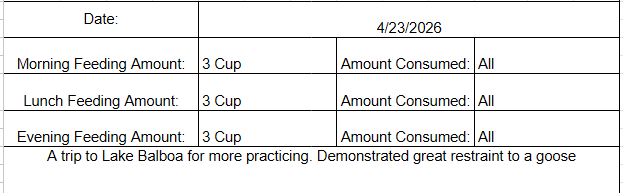
Today we returned to Lake Balboa to continue building on Chip’s training, and while it wasn’t the bustling environment we often hope for; fewer bikes, people, and dogs; it actually turned into a valuable session in its own right. Lower-distraction days like this are important because they give us the chance to reinforce behaviors with more clarity and less pressure. Instead of juggling a dozen stimuli at once, Chip could focus more directly on me, helping solidify expectations before we reintroduce heavier distractions later.
Even with the calmer setting, nature made sure we weren’t short on challenges. The geese and ducks were out in full force, goslings included, which brought a different kind of intensity. At one point, a protective goose approached us, hissing and posturing defensively for her young. She approached us with that threatening display. Chip’s body language shifted immediately; his ears pinned slightly back, posture stiffened, and you could see that uncertainty ripple through him. He wasn’t exploding or reacting wildly, but he was clearly unsure and looking for guidance.
That moment became a great teaching opportunity. I stepped in calmly and confidently between Chip and the goose, advocating for him and showing that I’ll handle potential threats. This is a key part of building trust, he doesn’t need to make decisions in those tense moments, I do. With that reassurance, we were able to continue walking forward, and as expected, the goose returned to her babies once we created distance. Chip followed my lead, and while still a bit cautious, he recovered nicely and stayed engaged.
Despite the lighter crowd, we took full advantage of the environment to keep polishing his “Heel” and “Come to Sit.” Without overwhelming distractions, his responses were cleaner and more thoughtful, and his body language reflected a calmer, more focused mindset overall. These quieter reps are what help behaviors stick when things inevitably get more chaotic.
Tomorrow, we’re setting our sights on a much busier scene at Santa Monica Pier; so today’s session laid the groundwork for that jump in difficulty. If he can take what he practiced here and apply it there, we’ll be in a great spot.
Until next time… let’s see if Chip can cash in his chips on a big day out tomorrow.
Pupdate 4/24/2026


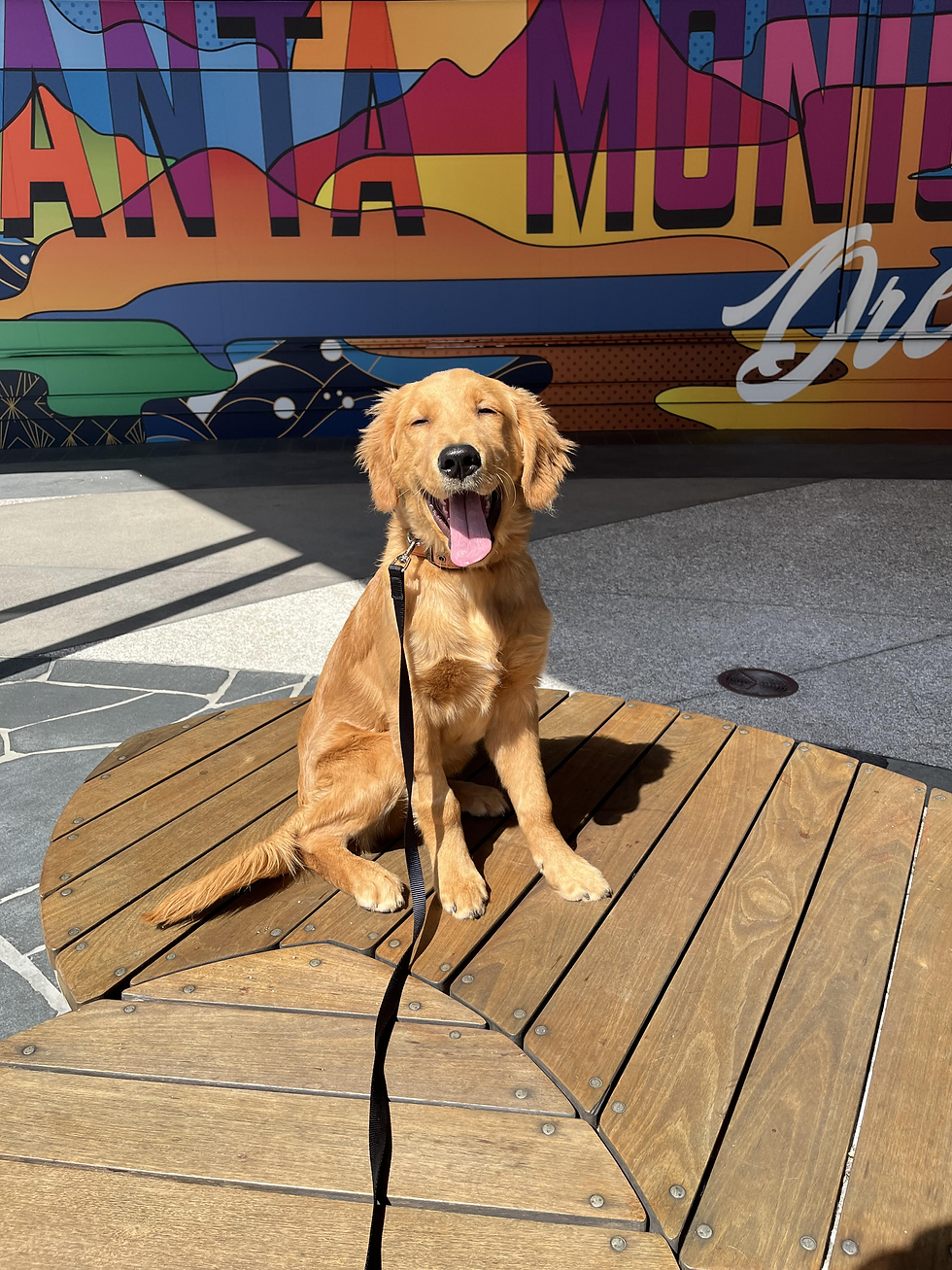
Today was a big adventure for Chip; we headed out to the Promenade in Santa Monica, and what an experience it was! Between the music, crowds, kids, and constant movement, it’s about as stimulating as it gets for a young pup.
At first, it was understandably overwhelming for him. Chip stayed very close to me, showing some initial uncertainty in his body language—slightly lowered posture, sticking near my side, and checking in often. It was clear he was taking everything in and trying to process the busy environment. For a pup his age, that kind of response is completely normal and honestly exactly what you want to see, awareness without panic.
As we spent more time there, though, I watched him start to settle. His body loosened up, his movements became more confident, and he began to engage with the environment instead of just observing it. That shift was great to see. He started coming out of his shell, showing curiosity rather than hesitation.
Chip also became quite the center of attention; lots of people wanted to say hello! This gave us the perfect opportunity to work on greeting manners. He handled it really well overall, learning to stay composed and polite despite the excitement.
We continued our training throughout, and he truly impressed me. He showed a strong understanding of his commands and demonstrated that he’s getting very close to being ready for off-leash work. That kind of focus in such a high-distraction environment says a lot about his progress.
We ended up staying a bit longer than expected, but it was well worth it. By the time we got home, Chip was more than ready for a hearty supper; and after all that stimulation and effort, he settled in for a very well-deserved nap.
Yesterday evening we had a small but important learning moment. As Chip was being let out to go potty, there ended up being a longer delay than ideal between him coming out of the crate and getting to the door. At that point, he simply couldn’t hold it any longer and started to pee inside.
In that moment, the right approach was taken; there was no punishment or negative reaction toward Chip. Instead, he was calmly and quickly redirected outside to finish where he should be going. This is key, because at his age, this wasn’t disobedience, it was a timing issue. Punishing him would only create confusion or hesitation around pottying, rather than teaching him the correct behavior.
Afterward, the focus shifted to management and prevention. Tightening up the routine, especially minimizing delays between crate time and getting outside, sets him up for success. Making sure he gets out promptly reinforces the habit of going in the correct place and helps build consistency.
I’m happy to report that today, there have been no repeats of the incident. That tells us he’s understanding the expectation, and with better timing on our end, he’s able to succeed. Accidents like this are part of the process, and how they’re handled makes all the difference, and Chip handled the follow-up beautifully.
He’s learning, he’s progressing, and he’s right on track. Big day, big progress, and one very smart boy.

Pupdate 4/25/2026
Today marked our last full day together. We brushed up on our in-home manners, making sure those stayed sharp. Once I saw he was fully understanding of what was expected of him, I let Chip just be a puppy. After everything he’s learned, every moment of focus, every success he’s stacked one on top of the other, he’s more than earned it. He’s cashed in all his chips, hit the jackpot, and today was about enjoying the win.
So rather than structured drills, I gave him something just as important: freedom, play, and connection. I introduced a glimpse into his well-earned “off-duty” life by letting him spend time with my own dog, Moon. The two of them have built a genuine bond over these days, and watching them play today really showed how comfortable and happy Chip has become.
Loose bodies, bouncy movements, relaxed tails, and those classic play bows; it was all there. No tension, no uncertainty, just pure, joyful engagement.
This kind of day is more important than it might seem on the surface. Training isn’t just about obedience: it’s about building a balanced dog. By allowing Chip to decompress and simply exist as a dog, we reinforce that calm behavior and good decisions lead to freedom. It prevents burnout, keeps his mind healthy, and strengthens his ability to switch between “working mode” and “relaxed mode.” That off-switch is just as valuable as a perfect “Heel” or “Place.”
Social play, especially with a trusted dog like Moon, also sharpens his communication skills. Dogs teach each other boundaries in ways we can’t replicate. Like when to push, when to pause, when to respect space. Chip showed us he can read those cues beautifully, adjusting his energy and play style in a way that speaks volumes about his growth.
Most importantly, today builds his confidence. A dog that knows how to relax, have fun, and feel safe is a dog that will carry that stability into every environment moving forward.
Chip didn’t just learn how to follow commands, he learned how to be a dog in a human world. And today, he got to celebrate that.
It has been my absolute pleasure to be with Chip on his journey. He's shown me just how smart he is and how driven he is to do his job and do it well. What a good boy!
Safe to say… this pup didn’t just train hard, he played his cards right and walked away with the whole Chip-otle.


Comments